There are weekends when national championships feel like a roll call. Names, medals, times, distances, podiums. Then there are weekends when they feel more like a weather report for the sport itself.
At Morton Stadium, Irish athletics offered something close to the latter.
Across two days at the 123.ie National Senior Track and Field Championships, the headline performances came quickly enough to resist neat packaging. Rhasidat Adeleke returned to the national stage and ran a championship record. Sophie O’Sullivan reclaimed the 1500m title by breaking a record set by her mother more than three decades earlier. Sarah Lavin extended one of the great domestic championship streaks in Irish athletics. Nicola Tuthill continued her quiet occupation of the hammer circle. Ciara Mageean, one of Ireland’s defining middle-distance runners, was honoured by more than 400 juvenile athletes in a scene that said as much about legacy as any result sheet could.
The championships are over now. Birmingham is next.
These were national titles, but they were also auditions, confirmations, returns, statements of health, and in some cases, reminders that athletes rarely arrive at championships carrying only their spikes and bib numbers.
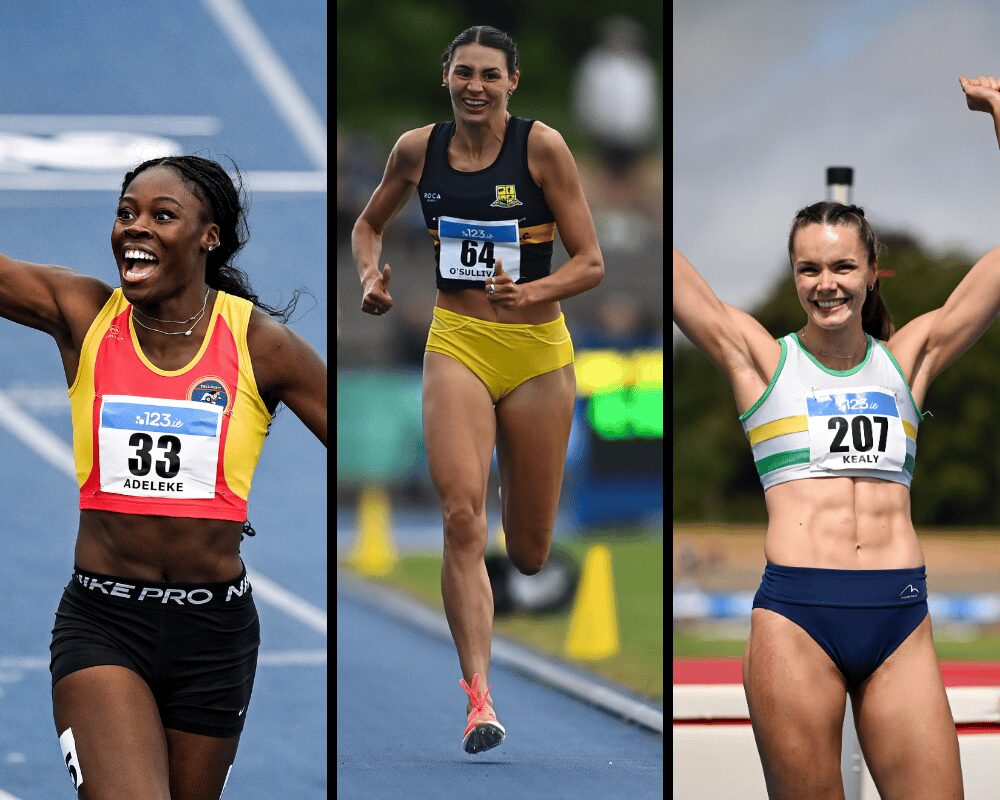
Adeleke’s 200m on day one was the performance that cut through everything. Running into a headwind, she powered to victory in 22.80 seconds, breaking the championship record and dipping under the European Championships qualifying standard of 22.85. It was her first senior outdoor national 200m title, and it came after what she described as a “rough year”.
That context matters. Adeleke has spent much of her young career being treated as inevitability in motion, as though progress should always be linear because talent has made it look that way before. Sport is less generous than that. The body interrupts. Form shifts. Confidence can narrow. A year that looks from the outside like a temporary inconvenience can feel very different inside it.
Her words afterwards gave the run its emotional weight. She said she had arrived without real expectations, wanting to show up in front of a home crowd and see what happened. Then she thanked the supporters, speaking about the messages she had received and how they had lifted her spirits at a time when she had been in a difficult place.
That was the more revealing detail. The time mattered because it booked Birmingham. The reaction mattered because it showed the athlete beneath the time.
Lauren Roy, who had entered the weekend with the fastest Irish time over 200m this season, took silver in 23.49. Lorena Harrison claimed bronze in 24.61. Sharlene Mawdsley, defending champion and one of Ireland’s most important relay figures, pulled up sharply approaching the final 100 metres. It was a reminder that championships can produce clarity and concern in the same minute.
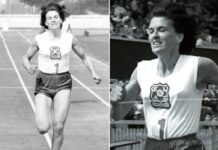
On day two, Sophie O’Sullivan stormed to victory in 4:05.62, reclaiming the national title and setting a new championship record. The previous mark, 4:07.09, had stood since 1995. It belonged to Sonia O’Sullivan.
There are sporting family lines that become suffocating through repetition, names treated as shorthand before an athlete has time to create their own shape. O’Sullivan has had to run with that history attached. Yet records have a useful brutality. They do not care about surname. They only move when someone runs faster.
This one moved.
Laura Nicholson’s silver in 4:08.27 and Jodie McCann’s bronze in 4:09.54 made it a high-quality podium, but the central image was unavoidable: a daughter taking ownership of a championship record once held by her mother. It was not imitation. It was continuation with a sharper time attached.
“I’m excited for the European Championships,” O’Sullivan said afterwards. “I’ll get back to training over the next couple of weeks and hopefully do something special.”
It was an understated line after a performance that did not need embroidery.
The middle-distance theme of the weekend widened through the tribute to Mageean. More than 400 juvenile athletes joined the European champion for the “Run with Ciara” celebration midway through the evening programme. It was one of those moments that can easily be flattened by sentiment, but the image carried its own force: young athletes from clubs across Ireland moving around Morton Stadium with a runner whose career has helped redraw the edges of ambition in Irish athletics.
Legacy in sport is often discussed too late, when the competitive years are finished and everyone is safer with praise. This felt more immediate. Mageean was not being honoured as a distant figure. She was being celebrated as someone whose impact is still alive in the lanes, in the clubs, in the children who now have a broader map of what an Irish athlete can be.
That map looked crowded by the end of the weekend.
Sarah Lavin secured her 11th national outdoor 100m hurdles title, winning in 13.34. Longevity is sometimes treated as the dull cousin of brilliance, but in domestic championship terms it is its own form of dominance. Lavin has kept coming back, kept winning, kept placing herself at the front of her event in a sport where the margins are too narrow for reputation to do much work. Amy Timoney took silver in 14.11, with Abigail Farrell third in 14.13.
In the 400m hurdles, Elle-Kate McRae produced one of the most striking breakthrough performances of the weekend, winning in 58.35 and setting national under-18 and under-20 records. Arlene Crossan finished close behind in 58.39, with Cara Murphy third in 58.98. It was a final decided by fractions and shaped by the kind of emerging talent that makes a national championship feel less like an ending than a warning.
There was depth, too, in the field events. Nicola Tuthill won the hammer with 70.16m, another performance from an athlete who has made high-level throwing one of the most reliable parts of the Irish programme. Margaret Hayden threw 63.61m for silver, while Kotryna Pacerinskaite took bronze with 57.22m.
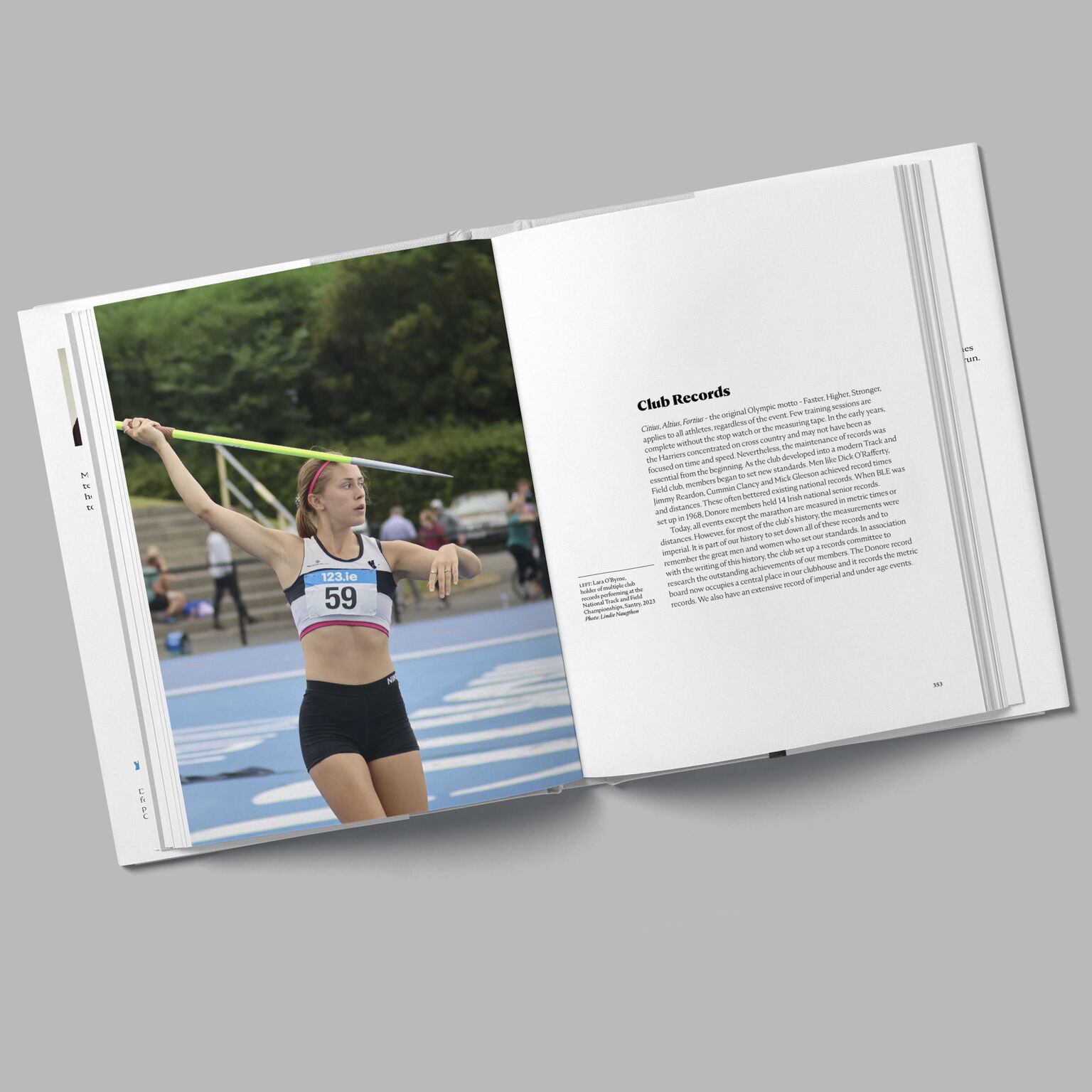
Ruby Millet won the long jump with 6.47m, just ahead of Lauren Callaghan on 6.45m and Elizabeth Ndudi on 6.42m, a podium separated by five centimetres. Anna Gavigan took the discus title with 54.51m. Clodagh Walsh won the pole vault with 3.65m. Daphni Doulaptsi Teeuwen defended her triple jump title on day one with 13.06m. Daena Kealy cleared a lifetime best of 1.87m to win the high jump. Kate Joyce claimed her first senior outdoor javelin title with 50.21m. Michaela Walsh captured her seventh outdoor national shot put title with 13.11m.
Individually, those results belong to separate event groups, training cultures and technical worlds. Together, they tell a more important story about range. Irish women’s athletics is not simply producing interest in the glamour lanes or the middle-distance races that come pre-loaded with history. It is producing champions across the programme.
Niamh Allen’s 5,000m win added another strong distance performance, as she defended her title with a personal best of 15:26.54. Fiona Everard stayed with her and took silver in 15:30.34, while Danielle Donegan completed the podium in 15:50.68. In the 800m, Madison Mooney took the national title in 2:04.38, ahead of Emma Moore in 2:04.59 and defending champion Alex O’Neill in 2:05.50. Rachel McCann won the 400m in 52.93, with Sophie Becker second in 53.23 and Michelle Duggan third in 53.72. Ciara Neville defended her 100m title in 11.44, taking the third senior outdoor crown of her career ahead of Mollie O’Reilly and Molly Scott.
On day one, Kate Veale delivered another reminder of endurance across years as much as kilometres, winning the women’s 5,000m race walk in 24:18.38 to secure her 24th national senior title across indoors and outdoors. Aisling Lane finished second in 24:21.03, with Leah O’Gara third in 24:22.91 after one of the weekend’s tightest finishes. Abbie Sheridan also retained her 3,000m steeplechase title in 9:55.60, ahead of Róisín Treacy and Dearbhla Allen.
The temptation after a championships like this is to reduce it to the biggest names. Adeleke because she commands attention. O’Sullivan because history wrapped itself neatly around her winning time. Mageean because the tribute reached beyond results. Those stories deserve the space they will get.
But the fuller picture is stronger.
This was a weekend of established excellence, returning belief, generational memory and new senior statements. It was Lavin still there. Tuthill still throwing far. Neville still defending. Allen getting faster. McRae arriving with records. O’Sullivan stepping into Birmingham with a championship record. Adeleke finding something at home when she needed it.