

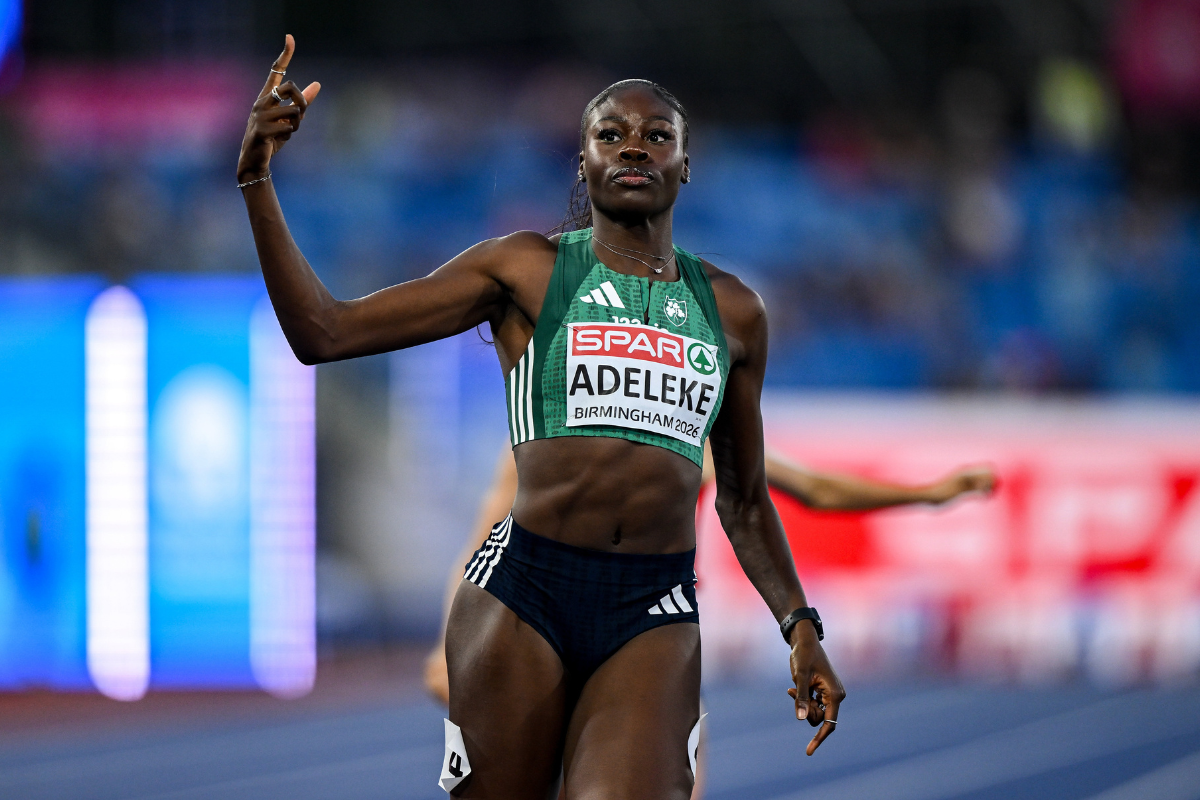
Rhasidat Adeleke crossed the finish line, raised one finger to the sky, then turned back towards the track and pointed down.
Maybe it is possible to read too much into a finish-line gesture. Maybe it was adrenaline, relief and the natural theatre of a sprinter who had just won a European Championship semi-final. It looked like something else too. A reminder. I am here. I am still here. Never doubt me too quickly.
Perhaps that gesture was aimed at the noise outside. Perhaps it was for those who had moved from concern to doubt, from patience to judgement, from asking whether she was fit to wondering whether she was checked out. The feeling was hard to miss. Adeleke looked pumped. She looked ready to fight. She looked like an athlete reminding everyone, and perhaps herself, that she is still that girl.
A few minutes later, Adeleke put words on the feeling.
“Sometimes when you’re down and things aren’t going well, you forget who you are,” she told RTÉ. “And today I was like, ‘You’re that girl. You can do this.’”
That was the significance of her 22.43 in Birmingham. It was the time. It was qualification. It was also the history. Adeleke becomes the first Irish woman to reach a European Championship 200m final. Her semi-final win made put hers through as the second-fastest qualifier overall, behind only Britain’s Amy Hunt, and placed her firmly in the medal conversation for Thursday night’s final.
It also has a deeper meaning in the answer it gave.
For months, the questions around Adeleke had grown louder. Was she fit? Had she gone backwards? Was the old sharpness still there? Could she get close to the athlete who had finished fourth in an Olympic 400m final, won European silver, broken Irish records and made the world take Irish sprinting seriously in a completely new way?
Birmingham gave the simplest answer available in sprinting: 22.43 seconds.
Class is not a slogan with Adeleke. It is written across her career. She is Ireland’s fastest woman over 100m, 200m and 400m. She holds seven Irish senior sprint records. She was NCAA 400m champion. She won European 400m silver in Rome in 49.07, an Irish record. She finished fourth in the 400m at the 2023 World Championships and fourth again at the Paris Olympics, missing an Olympic medal by the smallest of margins. This kind of talent does not vanish because one season becomes messy.
And Adeleke’s last year has been messy. In December, during a visit back to St Mark’s Junior National School in Tallaght, she spoke openly about how difficult 2025 had been. She said she is not usually injury prone, but that her body had been “breaking down” as training moved to another level. She spoke about hamstring, groin and knee issues, about being unable to build a consistent training cycle, and about a final hamstring strain that ended her season.
Athletes are often judged by the result sheet long before anyone gets a full picture of the body behind it.
Adeleke missed the 2025 World Championships in Tokyo through injury. She later described being there with Nike, watching instead of racing, as a bittersweet experience that gave her fuel for the following season. The research around her 2025 and 2026 period points to recurring physical interruptions, including reported hamstring and groin problems, with limited public detail around the full extent of those issues.
Then came this summer, when the concern felt more immediate. She returned over 400m in Eugene and ran 52.26, more than three seconds outside her Irish record. She withdrew from Monaco. She ran 23.07 over 200m in Lucerne, outside the European qualifying standard. RTÉ reported in July that her hopes of qualifying for Birmingham were narrowing after the Monaco withdrawal, with just over two weeks left to hit the standard.
At Santry, with pressure on, she found enough. Adeleke ran 22.80 to win the Irish 200m title and secure the European qualifying mark. Speaking afterwards, she said she was trying to work with the cards she had been dealt, and that adversity was new for her after a career that had often moved cleanly from one breakthrough to the next.
That line has followed her into Birmingham. She is learning what most elite athletes eventually learn: form can be fragile. Confidence can be fragile. The body can force patience on people who have spent their whole lives outrunning expectation.
The public is not always patient with them.
Adeleke has lived with expectation since she was a teenager. Every Irish record sharpened it. Every NCAA performance expanded it. Paris made it enormous. Fourth in an Olympic final should have been allowed to stand as one of the great Irish sprint performances. Instead, the gap to the medal became part of the next pressure point. When injuries and slower times followed, some people were too ready to speak as though the athlete herself had changed.
Michael Johnson’s words before Paris are worth remembering. Johnson, one of the greatest 200m and 400m runners in history. His own post-career projects can be debated, but his understanding of one-lap sprinting is not in question. When he speaks about the 400m, you listen.
Ahead of the Paris Olympics, Johnson looked at Adeleke and saw something obvious: speed. He said he agreed with Edrick Floréal that she needed to get out quicker in the 400m, because speed was her weapon. His point was technical and revealing. Against strength runners, Adeleke’s advantage lay in using her natural speed early and efficiently. Johnson even spoke about her being able to run the first 200m of a 400m in 23 seconds relaxed, because of the type of speed she possesses.
That was high praise from a man who knows exactly what separates a good sprinter from a dangerous one.
It also explains why the 200m matters for Adeleke now. Her 22.34 Irish record from 2023 remains elite European territory. Her 22.43 in Birmingham, with no wind, showed the speed is coming back at exactly the right time. The 400m has brought many of her biggest achievements, but the 200m gives her room to race with less calculation and more instinct.
She said as much afterwards. The 200m is fun. Less tactical. Less to think about. For an athlete who has spent the last year managing pain, expectation and pressure, fun might be more than a throwaway word. It might be the route back.
Adeleke hasn’t arrived to the final carrying just pressure. She’s arrived with a fresh piece of proof. A season’s best. A semi-final win. The feeling of executing under pressure again. The look of someone who has come through something difficult and found a bit of herself on the other side.
The final will not be easy. Hunt was the fastest qualifier in 22.37. Dina Asher-Smith, twice a European 200m champion, won her semi-final in 22.49. Fabienne Hoenke ran 22.46 behind Adeleke. A medal will likely require another season’s best or something close to Adeleke’s 22.34 personal best.
That is the beauty of where she now stands. Nothing has been handed back to her. She has forced her way back into the conversation.
Adeleke will run from lane six in Thursday night’s final, with Amy Hunt outside her in lane seven and Dina Asher-Smith in lane eight. That is a proper championship picture: Hunt with the fastest semi-final, Asher-Smith with the pedigree, Adeleke with the reminder that class has survived a difficult year.
The final is scheduled for 21:50 Irish time tonight and will be shown on RTÉ2.
Whatever happens, the semi-final has already changed the tone. She has shown enough to make the doubters uncomfortable.
When she pointed down at the track in Birmingham, it carried the feeling of someone staking a claim again. Maybe not in anger. Maybe not for anyone outside herself. Maybe simply because she needed to feel it.
I am here.
I am ready to fight.
I am still that girl.