

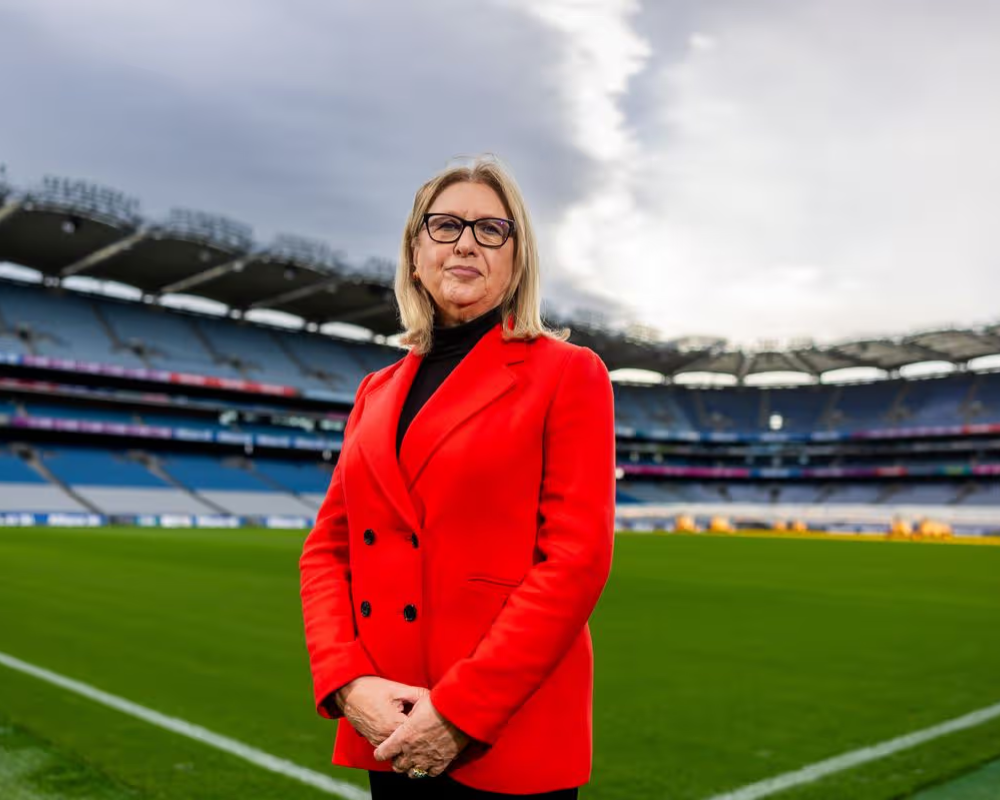
“I suspect that there are people who are not entirely happy about the idea of including women in decision-making at the top level of Gaelic sports.”
That was Mary McAleese on RTÉ Radio 1’s Inside Sport on Tuesday evening, hours after stepping down as chair of the committee overseeing integration between the GAA, LGFA and Camogie Association.
McAleese went further. She said the GAA had “blocked our progress”, “blocked our plan” and had “no other plan currently”. She also said she was shocked to hear current GAA president Derek Kent speak in favour of federation, adding: “Federation wasn’t what we were asked to four years ago to plan for.”
For anyone coming to this fresh, Gaelic games integration is the plan to bring the GAA, the Ladies Gaelic Football Association and the Camogie Association into one governing body. At the moment, the main Gaelic games are still split across three associations: the GAA, the LGFA and the Camogie Association. The proposed future was one association, one membership structure, and one governance system for Gaelic football, hurling, ladies football and camogie.
McAleese was appointed independent chair of the Steering Group on Integration in September 2022. The group first met in October that year, when it agreed that the future structure would be based on “One Association for all Gaelic games” and built on the principle of equality. A listening process began in February 2023, with workshops, submissions and meetings involving management, player representatives, counties, provinces, staff and clubs.
In February 2024, the three associations announced 2027 as the proposed date for full integration. That followed 18 months of consultation, including more than 30,000 respondents. The plan included work on membership, facilities, fixtures, finance, human resources and player welfare.
At the time, McAleese said the group had found a pathway to “One Association for all of Gaelic games by 2027”. Hilda Breslin, then Camogie Association president, described the aim as “one club, one county, one province, one congress, one association”.
The work continued through 2025. A joint update from the Steering Group said integration was “well on course”, with the next phase focused on one membership, integrated county and provincial structures, and one constitution for one association.
By September 2025, nine core principles had been published. The integrated body would be called the GAA. There would be a single membership structure. Club, county, provincial and national structures would remain. Competitions would continue across the four codes. Officer roles would largely remain, with extra roles introduced to make sure all codes were represented on management committees.
Those principles were still provisional. They needed to be debated and approved by the three national congresses. The authority, the Steering Group said, rested with the members. This summer, McAleese was still speaking as if that timetable held.
At an Oireachtas committee hearing in June, she said the group was on course to bring a near-final roadmap to the management committees of the three codes, before three special congresses in October. The aim was to establish one organisation and one membership from April 2027, followed by a glide path towards fuller integration at every level.
She also told the committee she had spoken at length with incoming GAA president Derek Kent, and said he was “100% behind the timeline, the new membership structure and the new organisation”.
Tuesday changed the whole temperature of the process.
RTÉ reported that the GAA told the Steering Group it could no longer commit to the definitive timeline for integration. The GAA wrote to the group on Monday asking for time to “pause and reflect”, with a greater focus on equity rather than equality. RTÉ also reported that the GAA proposal could extend the process by up to five years, while the association says it remains fully committed to integration.
A statement issued on McAleese’s behalf said the change created significant uncertainty around the agreed and publicly announced roadmap. In her view, that roadmap was effectively blocked and no alternative pathway had been offered. Her RTÉ interview sharpened that point.
“They continue to support integration and they were going to do all sorts of things to support integration,” McAleese said of the GAA’s position, “except that they weren’t actually going to do anything because they’ve blocked our progress. They blocked our plan and they have no other plan currently.”
The wording around equity and equality will now come under scrutiny.
Equality was one of the founding principles of the integration process. Equity can be a serious and useful principle when it means resources are targeted according to need. In this case, the shift has arrived with no published replacement timeline, no new pathway and no clear explanation for why the agreed April 2027 structure can no longer be met.
The federation point may prove just as important. Integration means one association. Federation suggests separate bodies held together under a looser structure. McAleese’s point was simple: she had not been asked to design federation. She had been asked to chair a process towards integration.
The Gaelic Players Association has responded strongly.
In a statement posted on Instagram, the GPA thanked McAleese for her leadership and said it shared her disappointment that the agreed roadmap had been disrupted. It pointed to what it called an overwhelming mandate for integration: a GPA motion backed by 89.8% of delegates at GAA Congress in 2022, consultation in which 97% of inter-county players supported integration, and a 2023 survey of more than 30,000 members across the three associations, where nine out of 10 believed integration would be positive for Gaelic games.
The players’ body is now seeking answers to five questions: what has changed since the roadmap and April 2027 timeline were agreed, how the decision to move away from that roadmap was reached, why such a significant change was not raised when the GPA met senior GAA leadership within the past week, what new pathway and timeline will replace it, and how the mandate from players, Congress and the wider membership will be respected.
The GPA said players will not accept an indefinite delay or a retreat from the commitment already made. It will consult players in the coming days before deciding its next steps.
The political response has also begun. The42 reported that Fine Gael senator Evanne Ní Chuilinn criticised the GAA’s position, saying no other organisation would “get away” with behaving that way in relation to women. The same report said Minister for Sport Patrick O’Donoghue was understood to be frustrated by the proposed new timeline and had asked senior GAA leadership to attend talks on integration.
Ní Chuilinn later framed the issue as one of governance as much as frustration. Decisions had been taken at Congress. Votes had been counted. A timeline had been restated at an Oireachtas committee only months ago. Her view was that a management committee should have to explain the authority by which it can now move away from that process.
There had been signs of tension before this week. The Irish Times reported that GAA officials had already described the 2027 deadline as unrealistic at a management committee meeting last December. McAleese rejected that view at the time.
The concern around facilities, cost and club structures is real. Gaelic games is one of the largest amateur sporting ecosystems in the country. Many clubs already operate across men’s football, hurling, ladies football and camogie in different ways, with different facilities, committees, finances and histories. Some clubs are already effectively integrated. Others are separate bodies sharing pitches, volunteers, players and calendars across the same community.
McAleese’s argument, made repeatedly through the process, was that those problems had been heard and worked through. April 2027 was never presented as the day every clubhouse, fixture list and local structure would be fixed. It was the point at which one organisation and one membership would begin, with deeper implementation continuing after that.
That is the fault line now.
For female players, coaches, volunteers and administrators, integration has always carried more than governance language. It is tied to pitches, dressing rooms, funding, fixtures, medical support, voice, status and who sits in the room when decisions are made.
The next few days will show whether the GAA offers a replacement timeline, whether the Special Congresses planned for October can survive, and how the LGFA and Camogie Association respond to a roadmap that now appears to have lost the backing of the largest body in the process.
The mandate for integration has been voted on, surveyed, endorsed and restated for four years. Gaelic games now has to decide whether it still intends to deliver it.
You can listen to the full interview here:
https://www.rte.ie/radio/radio1/clips/ef332c45-1c60-4ddd-a47a-b4bf0126d267