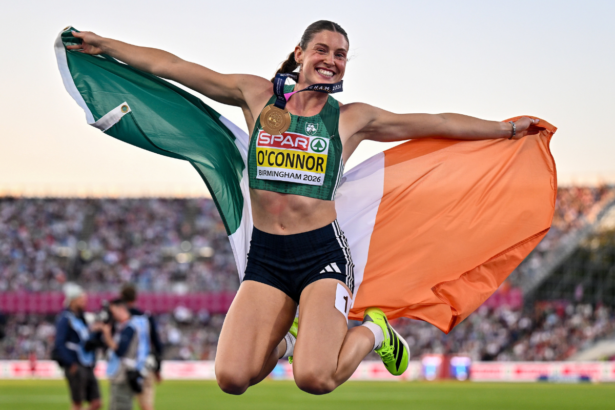


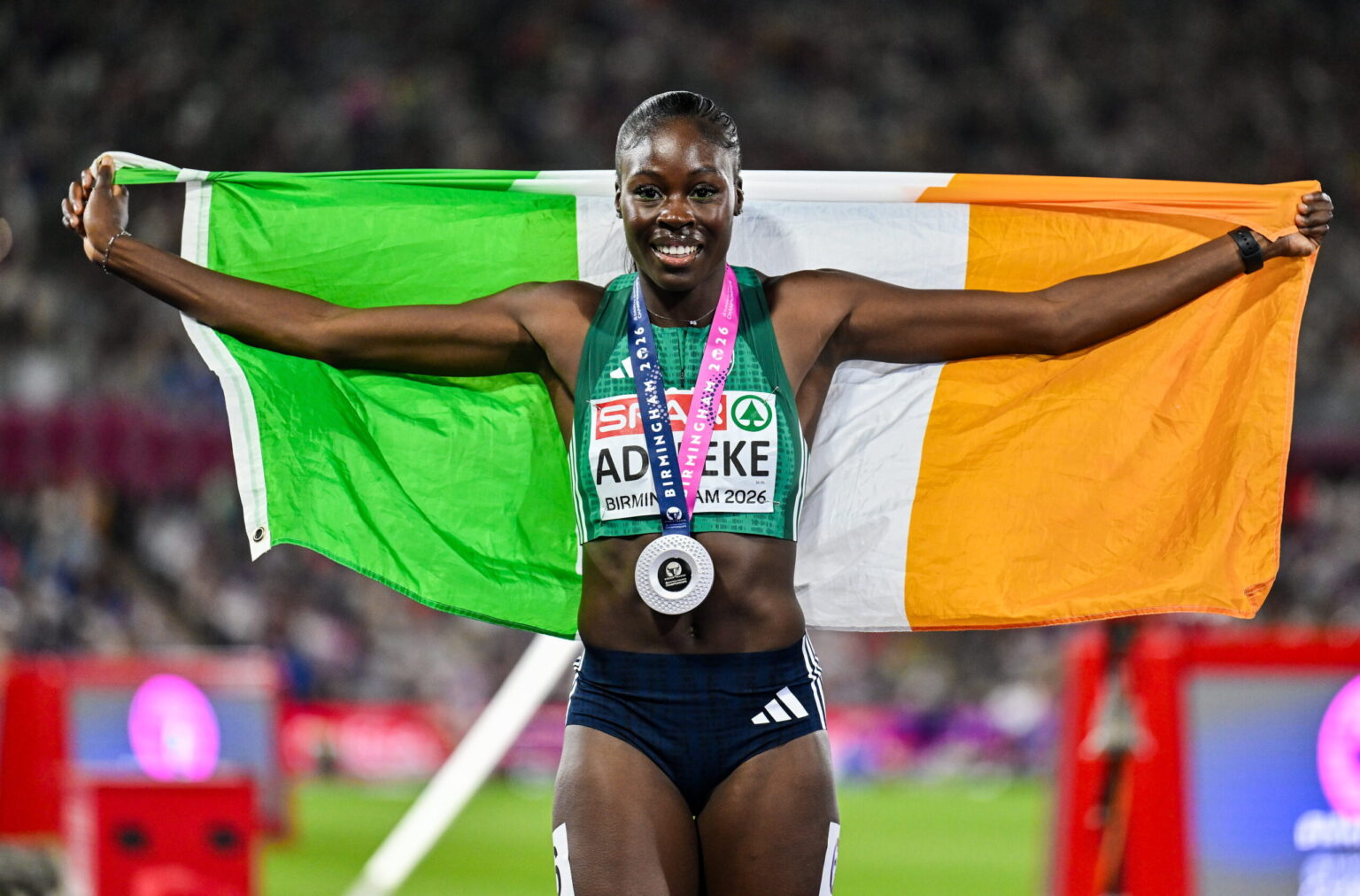
At the end, she was still coming.
Amy Hunt had done enough for gold. Dina Asher-Smith had got away quickly too, the old championship reflex still there, the bend sharp, the stride familiar, the podium beginning to take shape. Rhasidat Adeleke, out in lane six, had work to do.
Then the race began to change.
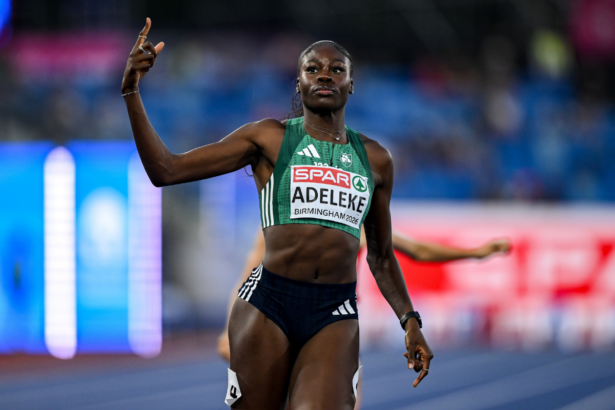
With around 60 metres left, Adeleke started to pull Asher-Smith back. There was no flailing, no panic, no sudden collapse in front of her. Just the steady closing force of a sprinter who looked, with every stride, like she had remembered something. The gap shortened. Then shortened again. The line arrived with silver still available.
Adeleke got there first.
Second place. 22.28 seconds. A new Irish record. Ireland’s first ever European Championship medal in the 200m.
Hunt won in 22.19 to complete the European sprint double, adding 200m gold to the 100m title she had won earlier in the week. Adeleke took silver in 22.28. Asher-Smith took bronze in 22.29. One hundredth of a second separated Adeleke from one of the great European 200m runners. It was enough.
The surface of the result is already extraordinary.
Ireland had never previously won a European 200m medal, women’s or men’s. Before this week, no Irish woman had reached a European Championship 200m final. Adeleke has turned both of those facts into history inside two nights.
There is the record too. Her previous Irish 200m best was 22.34, set in 2023. Birmingham has lowered it to 22.28. National records are not supposed to arrive this calmly, in a European final, with Asher-Smith beside you and the medal line narrowing by the metre.
For most athletes, that would be enough material for a career-defining night. For Adeleke, it sits inside something wider and more demanding.
Speaking to RTÉ afterwards, she admitted her first instinct was frustration.
“When I crossed the finish line initially I was disappointed I didn’t win but … I don’t want to be that person anymore. I realised I broke the national record and from where I’ve came from, I have nothing else but to be grateful.”
That was revealing. Even after silver. Even after a national record. Even after Ireland’s first ever European 200m medal. The first thought was still the gold that had got away.
Then came the correction. The perspective. The attempt to let herself feel the size of what she had just done.
“I’m back and better. Who would have thought? It means so much to me, just knowing the journey [it’s been]. The pressure has been so heavy to carry, people asking me why I’m not racing and all of that. I just want to enjoy this journey.”
That might be the most important line of the night.
Adeleke did not arrive in Birmingham as the clean, frictionless version of herself that people prefer to remember. She arrived after a year that had pulled at the certainty around her. Her 2025 season was interrupted by injury. She missed the World Championships. The pattern was clear enough: hamstring trouble, hip issues, broken rhythm, a body that would not let her build the way she wanted.
This summer hardly began like a straight road to silver either.
A few weeks ago in Eugene, she ran 52.26 for 400m, a long way from the 49.07 that won her European silver in Rome in 2024. It was one of the hardest watches of her senior career, partly because of the time, partly because of what it seemed to say about rhythm, sharpness and trust in the body. In Lucerne, she ran 23.07 over 200m, outside the European qualifying standard. Her championship place was still unresolved with the window closing.
Then came Santry.
At the Irish Championships, Adeleke ran 22.80 into a headwind to win the 200m title and secure the European qualifying time. It got her to Birmingham. At the time, that was the job. Now it looks like the first step in a much larger turn.
Santry: 22.80.
Birmingham heat: 22.60.
Birmingham semi-final: 22.43.
Birmingham final: 22.28.
That is not a tidy form graph. It is an athlete getting herself out of trouble at championship speed.
Adeleke put the doubt more plainly afterwards.
“There’s been so many times I thought… am I cooked?!”
There is a reason that line will travel. It is funny, sharp and painfully honest. It is also the kind of thing athletes rarely admit when they are still expected to look bulletproof. Adeleke said it after running 22.28 in a European final.
That is the emotional weight of this medal. The clock tells one part of the story. The quote tells the other.
Adeleke has spent much of her career making large steps look strangely normal. European age-grade titles. NCAA 400m champion. Irish record after Irish record. Fourth in the world. Fourth at the Olympics. European 400m silver. European relay gold. European relay silver. At 23, she is already Ireland’s fastest woman over 100m, 200m and 400m.
Rome in 2024 was the great surge. She helped Ireland win mixed 4x400m gold, the country’s first European relay title. She won individual 400m silver in 49.07, an Irish record. She then helped the women’s 4x400m relay team win silver in another national record. Three European medals in one championships. One gold, two silvers. A week that changed the texture of Irish sprinting.
Birmingham is different.
This medal came after the surge had been interrupted. It came after the year had become awkward, after the body had complicated the plan, after the external noise had grown louder, after the athlete herself had wondered whether the old feeling was still there.
It was.
The 200m has always been part of the Adeleke story, even when the 400m took most of the attention. Her Irish record before tonight was already elite. Her range has always been the point: short-sprint speed carried into long-sprint strength. That is why Michael Johnson’s comments before Paris still feel relevant. Johnson, one of the greatest 200m and 400m runners in history, looked at Adeleke and saw speed as her weapon. He was talking about how she could use it over 400m. Birmingham showed it in cleaner form.
The speed is still there.
So is the fight.
The final itself showed both. Hunt was the class of the field, a worthy champion and now a double European champion. Her week belongs in its own space. Asher-Smith had the start and the pedigree of an athlete who has lived in these finals for years. Adeleke had the race still in her legs when it seemed to be moving away from her.
That is a serious quality. It is one thing to be talented when the season is flowing. It is another thing to arrive with little certainty, build through the rounds, and then run the fastest 200m of your life while chasing down Dina Asher-Smith for silver.
That is pure talent. It is also pure determination.
It is tempting now to point ahead immediately. To LA. To the 400m. To the 200m. To whether she doubles at future championships. To how much faster she can go when the body gives her a cleaner year. That is the tax paid by exceptional athletes: every achievement becomes a prompt for the next argument.
This one deserves a moment before it is converted into projection.
Adeleke ran the fastest 200m of her life in a European final. She broke the Irish record. She beat Asher-Smith by one hundredth of a second. She won Ireland’s first medal in the event. She moved from a worrying 400m in Eugene to a European 200m podium in a matter of weeks.
The image that will last is the chase. Asher-Smith ahead. Adeleke coming. The Irish vest getting closer. The line arriving. The clock telling the rest.
22.28.
National record.
Silver.
For Ireland, it is another first.
For Adeleke, it may be something even more useful: a reason to trust the speed again, a reason to enjoy the journey again, a reason to believe that the difficult months have not narrowed what is possible.
Her first thought was that she had not won. Then she remembered the record, the journey, the pressure, the times she wondered whether she was cooked.
That, too, is part of the standard she is setting.
Rhasidat Adeleke is a European 200m silver medallist.
Ireland has never had one before.