


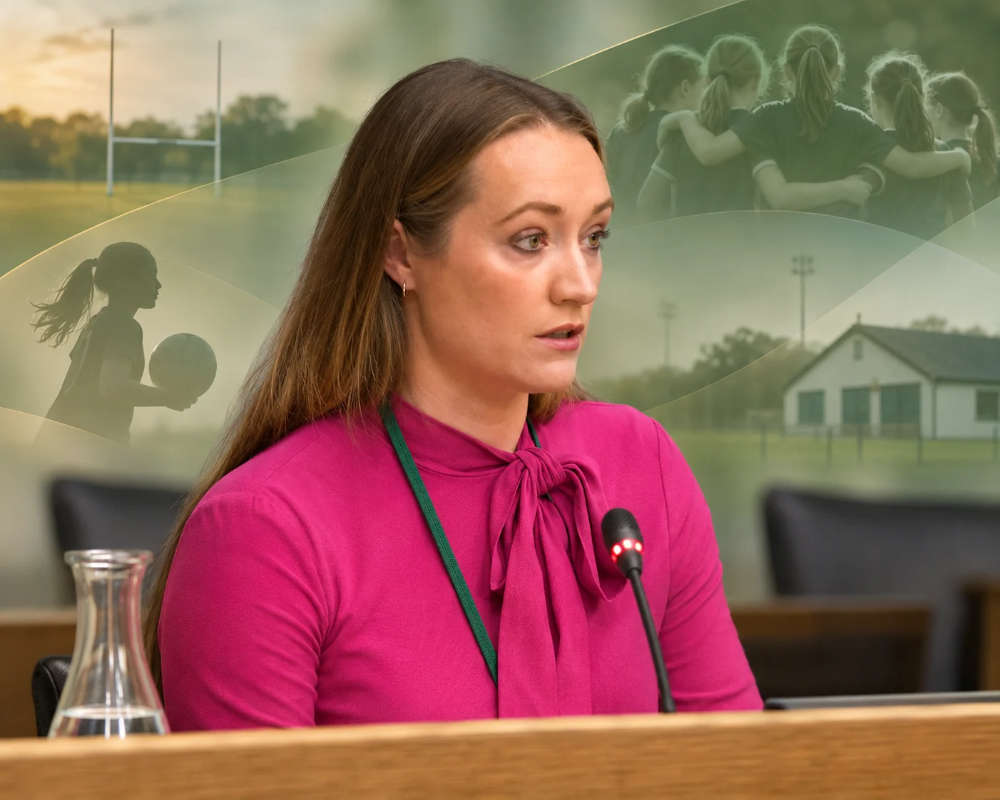
On 21 October we told the Joint Committee on Arts, Media, Communications, Culture and Sport that equality in Irish sport will be judged in local clubs, not at major events. Our founder and CEO Niamh Tallon addressed the committee, and we submitted a written brief with six recommendations. It was a privilege to be asked, and we hope to keep the conversation on inclusion in sport going.
Our vision is equal opportunity in sport regardless of gender and our submission sets out one clear test: a 13-year-old girl should get the same opportunities as a 13-year-old boy.
Where the gaps are
Sport Ireland’s Irish Sports Monitor 2025 found that 46 per cent of women and 50 per cent of men played sport weekly. The gap of four percentage points was up by a point on 2024, against a National Sports Policy target of closing it by 2027. The gap between higher and lower socio-economic groups reached 22 points, up from 19.
Most people who play sport are not elite athletes. They play in clubs, schools and parks, and that is where equal opportunity has to be experienced. Our brief argues that gender gaps compound with disadvantage, disability and rurality, so national averages understate the barrier for many girls.
Toilets and changing facilities come first. The FAI’s 2023 Facility Investment Vision and Strategy said 38 per cent of grassroots clubs had no female-friendly toilets at all. No comparable audit exists for other sports. It is a simple requirement, and girls and women need to be able to manage their periods at training and matches.
More Read

What has changed since 2024
We made four recommendations to the previous committee in March 2023, and the Oireachtas published them in February 2024. Our new brief builds on that record. One change stands out: half of a funded body’s core funding is now conditional on at least 40 per cent gender balance on its board. Sport Ireland’s snapshot found women held 48 per cent of board seats across funded bodies in November 2024, with 65 of 71 bodies at or above 40 per cent.
We think it is the clearest example of a policy that worked, though not every change can be put down to the condition alone. The rule also stops at national level. County boards and club committees decide who gets which pitch and which training slot, and we know of no published data on how many women sit on them.
Our six recommendations
The first is about Gaelic games integration. The GAA, LGFA and Camogie Association appeared before the same committee on 7 October, weeks after Mary McAleese stepped down as chair of the integration steering group. The Irish Times reported that the timeline was no clearer afterwards, and the GAA’s own management committee had described the 2027 target as unrealistic.
We asked the committee to seek, in writing before the three bodies return in December, a dated roadmap, safeguards for female representation and a commitment that girls and boys at club level get equitable pitch time and support now. For most members, integration means the local club: whether an eight-year-old girl and an eight-year-old boy get the same pitch, the same training times and the same coaching. That does not depend on settling inter-county finances.
The second and third are about facilities. Similar-access conditions already apply to the Sports Capital and Equipment Programme and the Large Scale Sport Infrastructure Fund, but no published information shows how compliance is checked once a grant is paid. We want the Department to publish its compliance process and introduce proportionate post-award monitoring that does not overload small volunteer clubs.
We also want capital programmes to adopt a female-considered standard covering toilets, changing rooms, private changing and showering areas, sanitary disposal, lighting and accessibility. England offers a comparison. The £30 million Lionesses Futures Fund requires funded pitches to reserve peak-time slots for women’s and girls’ teams.
The fourth is leadership. We asked Sport Ireland to extend its board snapshot to chairs, executives, county boards and club committees, with a phased target for county boards.
The fifth is parks. We recommended that a small number of local authorities pilot safety and access checks of parks and walking and running routes, covering lighting, winter opening hours, public toilets and transport links, and count how many women and girls use them before and after any improvements. The aim is a safer place for women to exercise through the winter months.
The sixth covers public funding and media. We asked that publicly funded women-in-sport programmes publish their objectives, reach and outcomes, that RTÉ and TG4 report their sport coverage by gender, that the review of the free-to-air events list be finalised, and that media monitoring extend to digital and social platforms. We also asked Coimisiún na Meán to review whether its funding, which currently supports television and radio programmes, should also support women’s sport content made for digital and social platforms.
The three Gaelic games bodies are due back before the committee in December. The question we have put to the committee for that hearing is the one at the heart of our brief: what will integration change for an eight-year-old girl at her local club, and why should equal pitch time wait?