

The old excuse was that nobody cared.
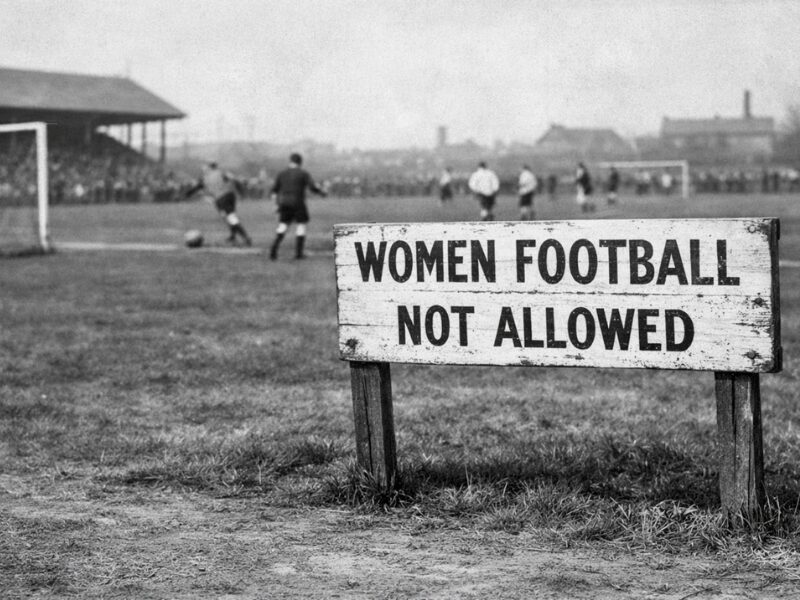
It was a useful excuse because it sounded like common sense. Broadcasters could point to ratings. Editors could point to audience habits. Sponsors could point to reach. If women’s sport was not visible, the explanation arrived before the question had even finished: there was no demand.
This was always a neat little trick. Men’s sport did not have to prove demand every morning. It was allowed bad games, empty seats, dull seasons, endless previews, speculative phone-ins, panels of former players saying very little with great conviction, and the full machinery of sport treating it as self-evidently important.
Women’s sport, meanwhile, was asked to arrive with evidence.
A record crowd. A viral clip. A major final. A national team. A marketable star. A reason.
For years, this was the quiet contract. Women’s sport could borrow the spotlight when the numbers became too large to ignore. Then the spotlight moved on.
18%.
Sport Ireland’s study of Irish sports media coverage found that women’s sport made up 18% of national sports-news coverage in 2025, while 22% of national radio sports-programming coverage focused on women’s sport. The generous reading is that this is far better than where Irish women’s sport used to be. The less comfortable reading is that more than four out of five national sports-news stories were still about something else.
Sport becomes part of public life through repetition. Fixtures are previewed. Players become familiar. Rivalries are explained. Results are debated. The next match is linked to the last one. A league table becomes something people check without thinking. That is how interest hardens into habit.
Men’s sport has lived inside that system for generations. Women’s sport is still too often asked to make do with moments.
The strange thing is that those moments keep getting bigger.
The 2023 FIFA Women’s World Cup drew a record attendance of 1,978,274, with FIFA saying almost two million fans attended in stadiums and two billion watched globally. UEFA Women’s EURO 2025 attracted 657,291 supporters, with 29 of 31 matches sold out, while 412 million watched live and more than 500 million followed overall. The 2025 Women’s Rugby World Cup final drew 81,885 fans and a UK television peak of 5.8 million, with World Rugby reporting that TV viewership across the tournament was up 545% in the UK alone.
These are not fringe numbers. They are not a polite round of applause at the edge of the market. They are evidence that when women’s sport is scheduled, promoted and made easy to find, people watch.
The audience is not imaginary. The access often is.
A DAZN report revealed across eight major markets, 66% of the total population said they were interested in at least one women’s sport. Yet 93% of sports fans watched men’s sport, while only 63% watched women’s sport. The same report found that 64% of consumers said they did not watch women’s sport because they did not know enough about the athletes and teams, did not have as many opportunities to watch, or did not know where to find the games.
This is where the old argument collapses. If people are interested but not watching, the question is no longer whether demand exists. It is whether the media has made following women’s sport harder than it needs to be.
For many fans, the answer is obvious. They know the work involved. Search the fixture. Find the stream. Follow the athlete. Hope someone posts the score. Wait for a clip. Check three social platforms. Explain to someone that the match already happened.
This is fandom as admin.
It is also one reason women’s sport has always been more digitally native. Fans had to become resourceful because mainstream media was inconsistent. If the match was not on television, they looked online. If newspapers did not profile the players, athletes told their own stories. If radio did not discuss the league, fans built the conversation themselves. Social media became the side entrance into a house that had been locked from the front.
That side entrance has changed the sport.
Sky Sports’ research found that 80% of UK sports fans are interested in at least one men’s and one women’s sport, rising to 85% among under-35s. Fans who follow both men’s and women’s sport spend five more hours per month on sports content, are 10% more likely to pay for sports content, and are passionate about twice as many sports as fans who follow only men’s sport.
The women’s sport audience is not some soft charity audience waiting to be educated. It includes highly engaged sports fans, younger fans, paying fans and crossover fans who already love sport. The commercial opportunity is sitting there in plain sight, occasionally waving a flag, while parts of the media still ask whether it exists.
Among under-35s, 37% were interested in player personalities and stories, but more than two in five found that content difficult to access. Only about half of women’s sport fans found content on female player skills easy to find, compared with more than two-thirds for men’s sport.
Fans want the stories. They cannot always find them.
This explains Ilona Maher better than most traditional sports coverage has managed. Maher is often described as a social-media sensation, which is accurate and incomplete. Her audience did not grow because she waited for rugby media to grant permission. It grew because she understood that modern fandom is built through access, personality, humour, body confidence, short-form video and the feeling that an athlete is speaking directly to people who have not always felt invited into the sport.
When Maher made her Bristol Bears debut in January 2025, the club moved the match to Ashton Gate because of demand. A record home crowd of 9,240 turned up. That is not a gimmick. That is what happens when an athlete brings new people to an old structure and the old structure has enough sense to open the gates.
Girls understand this intuitively. The “Fan Gap” report found that 57% of girls identify as sports fans. Among girl sports fans, 73% watch full matches, 83% watch short-form content, 84% talk about sport with family, 79% talk about it with friends, and 81% own branded sports merchandise.
Yet the same report found that girls’ fandom decreases with age. Among girls aged 11 to 13, 62% identify as sports fans. That falls to 56% among 14- to 15-year-olds and 50% among 16- to 17-year-olds. Boys do not show the same decline, sitting at 75%, 71% and 75% across the same age bands.
Visibility is one of those pathways. 40% of young people could not name a single sportswoman. Among girl sports fans, 80% wanted to know more about famous sportswomen, 67% wished they could name more sportswomen, and 76% wanted to know more about sportspeople who “look and sound like me”.
There is the loop again. Girls want more stories. Media does not tell enough of them. Familiarity stays low. Then the lack of familiarity is treated as proof that the audience is not there.
Very tidy. Also ridiculous.
Ireland has its own version of this. KPMG research conducted by Bounce Insights found that 92% of respondents in Ireland agreed female sports stars have a positive impact on society. It also found that 61% were motivated by Irish female athletes’ achievements on the world stage, and 30% had taken up a sport or exercised more as a result.
This is the social value of visibility. It is not an abstract complaint from media people who want more column inches. It affects what people try, who they recognise, what children imagine, and whether women’s sport is treated as part of the national sporting conversation or an occasional uplifting segment near the end.
The Irish media system should take this seriously because the issue is structural. Women make up 40% of sports participants but women comprise of just 14% of sports-related news subjects worldwide compared with 86% for men. Less than 4% of more than 1,600 Irish Times sports photographs over a four-month period were of sportswomen.
The point is not that nothing has changed. It has. The point is that the pattern is old, deep and very good at rebranding itself as normal.
Women’s sport needs that ordinary attention.
That is where public service media becomes unavoidable. In Ireland, RTÉ and TG4 are public service media organisations. Coimisiún na Meán says their services are required, as far as reasonably practicable, to be available to the whole community of the island of Ireland, and that public service media must demonstrate transparency and accountability in the use of public funds.
If public service media is for the whole community, women’s sport cannot be treated as a niche favour. Ireland’s population is broadly split between women and men. The CSO’s administrative population estimates for 2022 recorded 2.56 million females and 2.61 million males in the State.
Public service does not mean every sport gets the same slot or every fixture gets broadcast. Nobody serious is arguing that. It means the logic behind coverage should be visible, measurable and accountable. If taxpayers help fund national media, then the public should know whether women’s sport is being properly represented across television, radio, digital, news, highlights, analysis and promotion.
This should not require a one-off study every few years. It should be tracked.
The Swedish example shows what happens when measurement becomes policy. SVT Sport, Sweden’s public broadcaster’s sports department, set a goal in 2015 to work towards equal coverage of sportswomen and sportsmen. By 2018, it said its combined coverage across television news, website and social media had reached 50-50. The lesson is not that Ireland can copy Sweden line by line. The lesson is that imbalance changes when an organisation names it, measures it and decides it is an editorial problem rather than a natural condition.
Ireland needs that level of seriousness. Independent tracking of sports media by gender, sport, platform, prominence and quality. Public reporting from broadcasters. Clearer accountability around publicly funded sport coverage. Less congratulation for occasional peaks and more attention to the weekly base.
This is why Her Sport exists. A digital-first women’s sport platform that has been able to step into the gap because the old system left room. Her Sport doesn’t carry the same legacy assumptions and can move quickly, publish often, explain the context, build athlete familiarity, and treat women’s sport as daily life rather than special programming.
But digital success cannot let mainstream media off the hook.
Women’s sport needs Her Sport and RTÉ. TG4 and TikTok. Newspapers and newsletters. Radio and reels. Match reports and short clips. Live games and athlete profiles. Deep analysis and easy fixture guides. The viral moment and the boring weekly preview that tells people where to watch next.
Social media has shown the appetite. Mainstream media now has to stop acting surprised every time the appetite appears.
Ireland has spent years asking whether women’s sport can attract an audience.
It can.
The better question is why Irish sports media is still giving it 18%.