
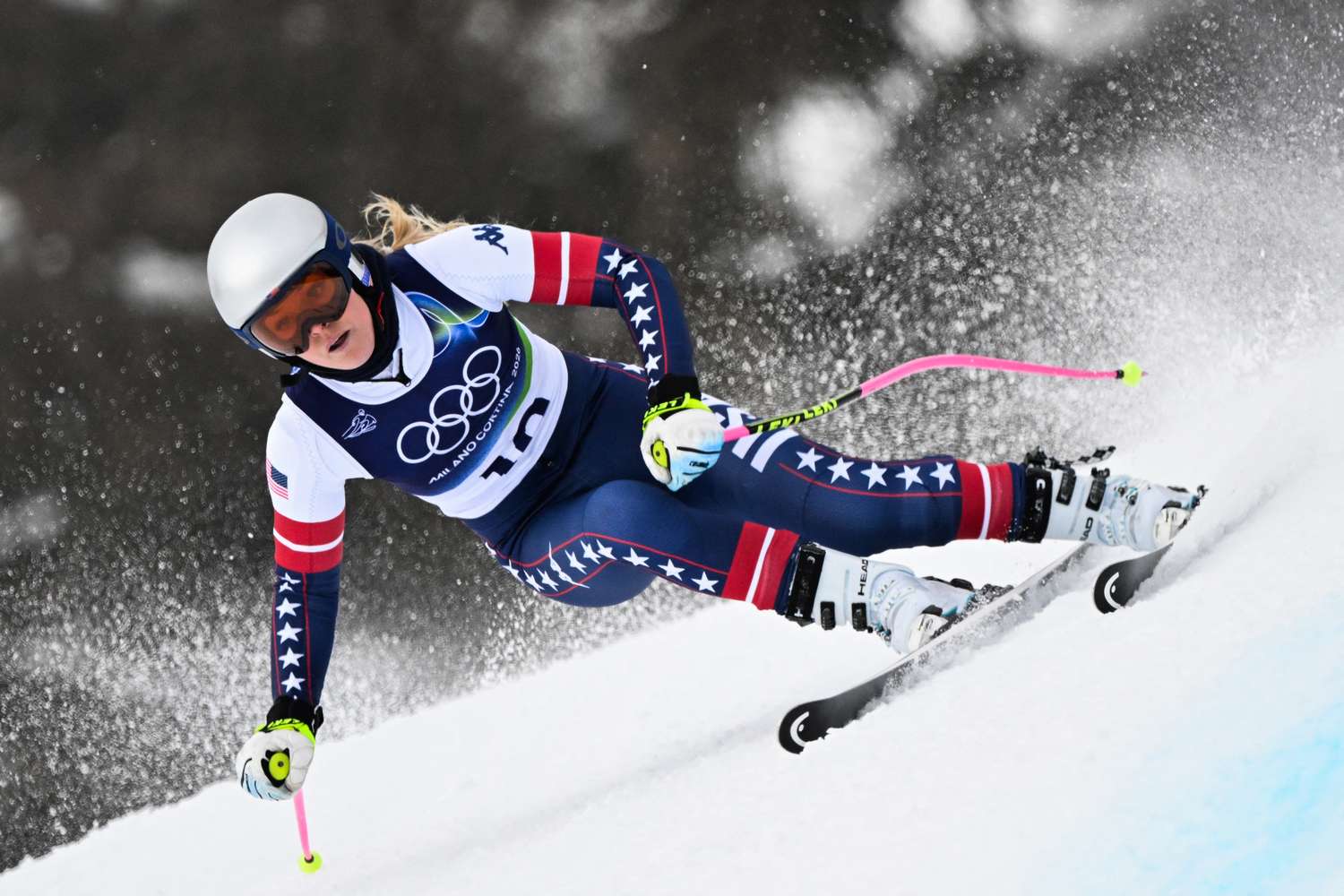
On the Olympia delle Tofane, speed arrives before thought. The course begins with that opening traverse where the skis skim, the body settles, and the line has to be trusted long before it can be checked. Lindsey Vonn pushed out as the 13th starter in the Olympic women’s downhill in Cortina d’Ampezzo on Sunday, and the entire race seemed to hold its breath with her.
It lasted 13 seconds.
Vonn, 41, racing with a ruptured ACL in her left knee, cut the line too tight on the opening traverse, lost control, and was spun around in the air. She crashed before the first timing marker, her screams audible as medical personnel surrounded her. The race halted for more than 20 minutes while she was treated on the snow, then she was strapped to a gurney and flown away by helicopter, her Olympic downhill over before it had properly begun.
Our @AP photographer Jacquelyn Martin got this incredible shot moments before Lindsey Vonn crashed at the Milan Cortina Olympics. pic.twitter.com/eY2O2emdsj
— Tim Reynolds (@ByTimReynolds) February 8, 2026
Downhill has a blunt honesty. The mountain does not negotiate. It rewards conviction, punishes tiny errors, and ignores reputation. Vonn has built a career on accepting that bargain. This was her fifth Olympics, and the story of this one already carried a serrated edge.
She retired in 2019 after years of damage and repair to her right knee. She returned after a partial right knee replacement, in an era when elite comebacks are supposed to be managed, curated, softened at the edges. Instead she came back as herself: straight into the steep end, back into the discipline where the speeds climb towards 70 and 80 miles an hour and the consequences arrive in the same breath as the mistake.
Her form made the whole thing feel plausible. Across the five World Cup downhills she entered this season, she finished on the podium every time, winning twice, taking the red bib as the discipline leader. The scepticism that had greeted her return didn’t vanish so much as it ran out of arguments.
Then, nine days before the Olympics, the sport did what it does. In Crans-Montana she crashed in the final World Cup downhill before the Games, was airlifted to hospital, and scans confirmed a complete rupture of her left ACL along with bone bruising and meniscus damage. In most sports, an ACL tear draws a line under the season. Downhill lives in a stranger place: less cutting and pivoting than other disciplines, more speed than anything else, and an unforgiving tax on the body every time the skis reconnect with the snow after a jump.
Vonn chose to race anyway.
She trained in Cortina wearing a brace, trying to find evidence that the knee could hold the load. She put down times quick enough to keep the story alive, including a session where she was third-fastest. Her coach, Aksel Lund Svindal, talked about calm and symmetry, about skiing that looked balanced rather than protective. The gamble was clear: trust strength, trust muscle, trust instinct, then ask the mountain to accept the terms.
On Sunday, the mountain answered in its own language.
The crash drained the theatre from the day. The crowd at the bottom fell into a kind of stunned quiet as the stretcher came out. In the stands her family watched, motionless, as she was treated and then lifted away. Even for a sport that has always carried the shadow of danger, there are moments that make it feel newly sharp.
The race carried on, because the race always carries on. It produced a winner worthy of the stage.
Breezy Johnson, Vonn’s teammate, won Olympic gold with a time of 1:36.10, edging Germany’s Emma Aicher by four hundredths of a second, with Italy’s Sofia Goggia taking bronze. Johnson became only the second American woman, alongside Vonn, to win Olympic downhill gold. She watched Vonn’s crash on the big screen at the finish and later spoke of concern, the words of an athlete who understands how quickly this hill can turn on you.
FIRST MEDAL FOR TEAM USA. 🥇
— Team USA (@TeamUSA) February 8, 2026
Breezy Johnson delivers Team USA’s first medal of the #WinterOlympics in the women’s downhill final. pic.twitter.com/gCZePRaQ42
There is a particular cruelty in how sport stacks its moments. Johnson’s run, the sixth down the course, was a proper downhill performance: committed, clean enough, fast enough to force everyone else to chase. She then had to sit and wait through the delays, through the silence, through the unsettled mood that followed Vonn’s fall, and still hold the line when the margins became microscopic.
Cortina has always been stitched into Vonn’s identity. She has 12 World Cup wins on this course, more than anywhere else in a career that totals 84 World Cup victories. She has been called the queen of Cortina because the place suited her: the terrain, the rhythm, the way the mountain asks you to be brave without being careless. That history mattered to her decision to come back. It is why the ending felt so wrong-footed, the same slope that has carried her towards so many finish lines carrying her away instead.
What happens next will be written by scans and swelling and decisions made in quiet rooms. Whether she races again, whether this is the final image of her Olympic career, nobody yet knows. But the shape of the day is already fixed.
Vonn arrived in Cortina as the Games’ biggest alpine storyline, carrying the myth of the comeback and the arithmetic of time, a 41-year-old trying to bend the sport’s usual rules. She left it after 13 seconds, airlifted from the course she knows better than anyone, while her teammate won gold in a race that will always be remembered with a pause in the middle of it.