Support for women’s sport is often expressed in safe terms. A statement here, a campaign there, a general agreement that things should improve. It rarely interrupts anything.
Andy Murray’s version has tended to do the opposite.
He has made a habit of stepping into moments where the narrative is already moving and changing it in real time. Not through grand gestures, but through small, precise corrections that expose something bigger.
That matters because inequality in sport is rarely sustained by one clear decision. It is reinforced through repetition. Through who gets mentioned first. Through who is forgotten. Through language that treats men as the default and women as the exception.
Murray has spent years refusing to let those moments pass.
His authority allows him to do that. Few players in tennis have operated at his level. World number one for 41 weeks, three Grand Slam titles, two Olympic gold medals. That kind of career does not only bring success. It brings influence. When someone in that position speaks, it carries.
What separates Murray is how he has used that position.
One of the clearest examples came during Wimbledon in 2017. A journalist described Sam Querrey as the first American to reach a Grand Slam semi-final since 2009. Murray interrupted with a correction: “Male player.”
It was a brief moment, but it cut through something deeper. Serena Williams had won multiple titles in that period. So had Venus Williams. They had not been forgotten by accident. They had been left out because the framing defaulted to men.
Murray did not allow that to stand.
He had done something similar the year before at the Olympics. When told he was the first tennis player to win two Olympic gold medals, he pointed out that Serena and Venus Williams had already won four each.
Again, the correction was simple. The implication was not. It highlighted how easily women’s achievements are excluded from what is presented as a complete record.
This is where Murray’s impact sits. Not only in what he believes, but in how he applies it.
He has spoken openly about the culture he has seen throughout his career. “I’ve been involved in sport my whole life and the level of sexism is unreal,” he said. That statement was not framed as opinion or debate. It was observation.
He has been equally clear on pay. When the conversation around equality in tennis resurfaced, he stated that women should have equal pay. There was no qualification attached to it.
These positions are often discussed in abstract terms. Murray has repeatedly brought them back into practical situations, where they become harder to ignore.
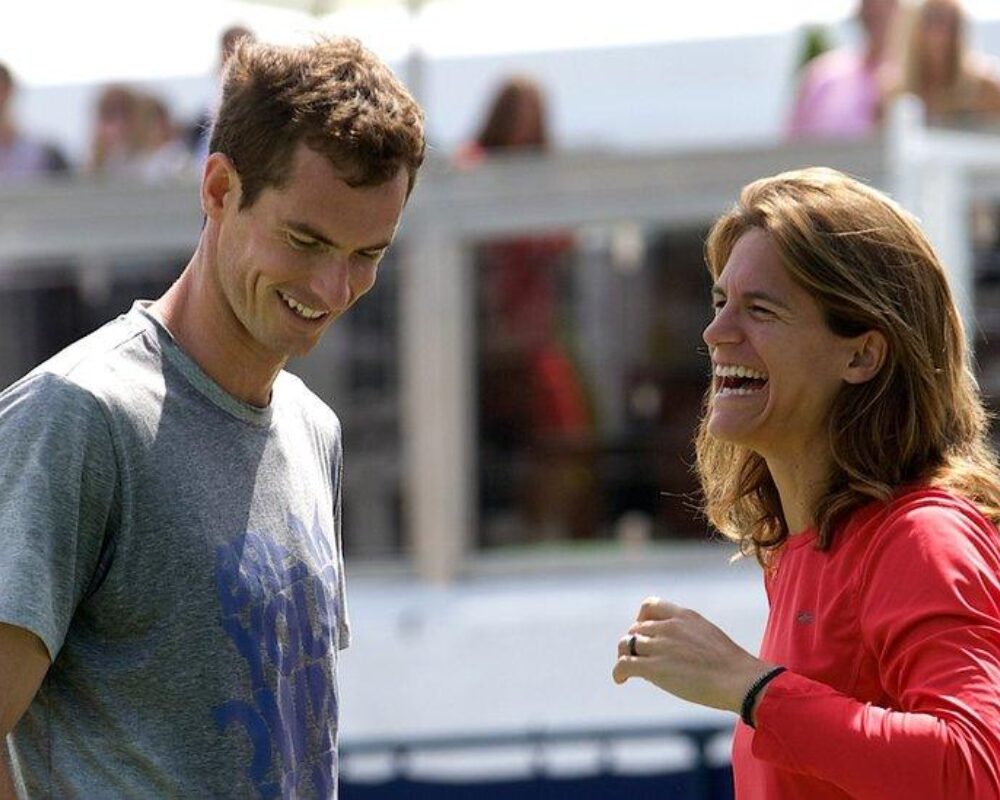
That was especially evident in his decision to hire Amélie Mauresmo as his coach in 2014.
The appointment itself was significant. Female coaches remain rare in men’s sport, particularly at the highest level. Murray described it as surprising how few there are across any sport.
What followed revealed why.
Mauresmo faced a level of criticism and scrutiny that Murray said his previous coaches had never experienced. She was blamed for defeats in a way that had not applied before. The reaction was not subtle. It exposed a bias that tends to stay hidden until it is tested.
Murray did not distance himself from that response. He addressed it directly. He said it was not right. He pointed out the difference in how she was treated. He returned to it again years later, making clear that the issue had not been imagined or exaggerated.
That matters because it moved the conversation out of theory. It showed what happens when a woman enters a role that has historically been occupied by men, and how quickly the standards around that role can shift.
Murray’s stance has also been recognised by those within the women’s game. Serena Williams spoke about the consistency of his support, noting that he has spoken up for women’s rights in tennis over a long period and that his impact has been felt across the tour.
That kind of recognition is not given lightly. It suggests that his advocacy has been sustained rather than occasional.
There is a wider point in that.
Men’s support for women’s sport is often treated as an addition. Something that sits alongside their own careers rather than shaping how they operate within them. Murray’s approach has been different. He has used moments within his own career to challenge the assumptions around him.
He has corrected language when it excludes women. He has backed equal pay without hesitation. He has made decisions that bring women into spaces where they are underrepresented, and then addressed the reaction when it reveals something uncomfortable.
None of this resolves inequality in sport. It does something else. It removes the ability to ignore it.
Fans pay attention to what leading athletes value. Media narratives shift when those athletes challenge them publicly. Institutions take notice when one of the sport’s most recognisable figures refuses to follow the expected line.
Women’s sport does not depend on male approval. It does, however, change more quickly when those with influence stop reinforcing the patterns that hold it back.
Andy Murray has understood that for a long time.
More importantly, he has acted on it.