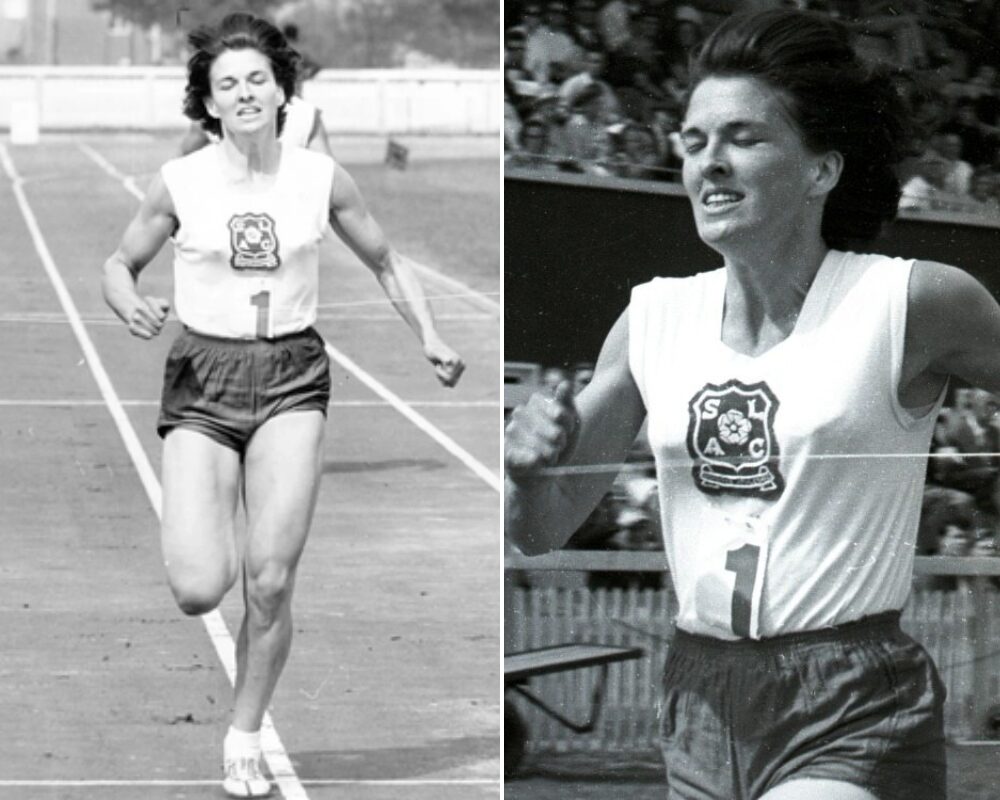
Before Maeve Kyle, Ireland did not send women to run.
The absence was not accidental. It reflected a system that had already decided what women could do, where they could go, and what counted as acceptable ambition. By the time Kyle stepped onto the track in 1956, the limits were long established and widely enforced.
No Irish woman had competed in Olympic track and field. That fact alone tells you what the structure looked like.
There had been Irish women at the Games before. Phoebe Blair-White and Hilda Wallis competed in 1924. Marguerite Dockrell followed in 1928. Their presence, though significant, did not extend into athletics. That remained closed. Not by lack of ability, but by expectation.
The expectation was clear. The 1937 Constitution set out a view of women’s place that prioritised the home. Sport, especially at elite level, sat outside that vision. It was not forbidden. It simply wasn’t considered.
That distinction matters. What is not imagined rarely becomes possible.
Maeve Kyle grew up outside that limitation. Not in theory, but in practice. Her father, headmaster of Kilkenny College, encouraged her involvement in sport alongside her brothers. That environment shaped what she believed she could do.
“Sport was part of my social life growing up. It didn’t cost you anything. It couldn’t because we had no money!”
She played rugby, hockey and swam with boys. There was no sense that she should do less. At thirteen, when told there would be no girls’ race, she offered a solution.
“I’ll run against the boys.”
She did. She won. Then she won again the following year.
That moment reads simply. It was not. It shows how early the boundary had to be challenged, and how often it had to be ignored before anything shifted.
Kyle did not begin in athletics. She built her reputation in hockey, earning 58 caps for Ireland and recognition on the World All-Star team. That exposure brought her into international sport, and with it, a different standard.
“Because of hockey, I was introduced to international sport quite early. Then, of course, you get a taste for that level.”
The transition to sprinting followed. Encouraged by her husband and coach, Sean Kyle, she began to train seriously. The training was demanding, often woven into daily life rather than separate from it.
“I remember some ferocious training in the winter. On Christmas Day, I was in the kitchen cooking dinner, and he’d say, ‘You’ve got a 15-minute run to do now before we sit down.’”
Even then, the idea of the Olympics remained distant.
“I said to him, ‘Don’t be silly. Ireland doesn’t send women to the Olympics.’”
That sentence carries more weight than it first appears. It was not self-doubt. It was a statement of reality.
When Kyle was selected for the 1956 Games in Melbourne, the reaction was immediate. Not curiosity. Not celebration. Resistance.
“My biggest claim to fame is that I was the first Irish woman to go to the Olympics. You could call me an athletic suffragette, I suppose.”
She also recalled being described as “a disgrace to motherhood and the Irish nation.”
The criticism did not come from nowhere. It followed a logic that had been in place for decades. Women competing internationally, particularly married women with children, disrupted that logic. They stepped outside what was considered appropriate.
Kyle travelled to Melbourne with her husband and two-year-old daughter. The journey took over two weeks and required raising £200. The scale of that effort underlines how far removed the opportunity was from normal life.
At the Games, she competed in the 100m and 200m. Even those distances reflected the limits imposed on women. At the time, they were not allowed to run further than 200 metres. It was considered dangerous.
“They felt we would require resuscitation if we ran any further,” she later said.
That detail is often treated as a curiosity. It is more than that. It shows how restriction was justified. Not through outright prohibition, but through claims about health, capability, and risk.
Kyle returned to the Olympics in 1960 and again in 1964. The introduction of the 400m and 800m opened new space, and she moved into it. The 400m became her event.
“To me, the 400 is the greatest event of the lot. You have to stay in your own lane. You’ve got to think. You can’t sprint the whole way.”
At 36, she reached the semi-finals in both the 400m and 800m. Two years later, she won bronze at the European Indoor Championships.
Those results matter. They establish her as more than a symbolic figure. She was competitive. She sustained that level over time. The breakthrough was not only participation. It was performance.
Yet the broader significance sits elsewhere.
Kyle did not operate within a system designed for her. She entered one that had not made space, and in doing so, altered what came next. Not immediately, and not completely. Change of that kind rarely happens quickly.
The numbers show the distance between then and now.
At the 2024 Olympic Games in Paris, Ireland sent 66 women. Fifteen competed in track and field.
That scale of participation suggests progress. It also highlights how long it took.
The shift did not begin with policy or reform. It began with presence. One athlete stepping into a space that had been closed.
Kyle’s story is often framed as a first. That is accurate. It is also incomplete. The significance lies in what that first made possible, and how it challenged the assumptions that had held for so long.
The limits placed on women in sport were never fixed. They were constructed, reinforced, and repeated. Kyle did not dismantle them alone. No individual could. What she did was expose them.
Once exposed, they become harder to defend.
Before Maeve Kyle, Ireland did not send women to run.
After her, it eventually had to.